Regarding AI, most organizations ask the wrong question: How do we get people to use it?
While that question matters, it is not enough. If, in fact, it becomes the only question organizations ask, it will ultimately lead them in the wrong direction.
The better question shifts the nucleus: How do we ensure people remain capable of judgment while using AI?
That is the question behind Fusion Compass.
AI is no longer a tool employees occasionally use. It is becoming an environment, woven into workflows, learning systems, customer interactions, hiring pipelines, strategic planning, performance management, and daily decision-making. It answers with speed, speaks with confidence, simulates empathy, and presents information with compelling structure before we have fully understood the problem ourselves.
That is precisely why it is powerful. And also, why it is dangerous.
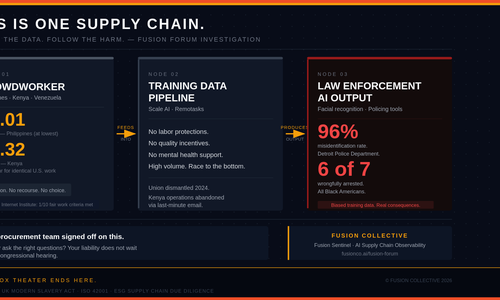
The greatest risk is not that AI will produce incorrect outputs. That risk is significant, and we have already witnessed the consequences of hallucination, bias, drift, policy deviation, and misuse. There is a deeper risk that receives far less attention because it is less sensational to discuss and far more difficult to address: the gradual erosion of human judgment, agency, and accountability through repeated, uncritical interactions with systems that appear intelligent, neutral, and authoritative.
Steven Shaw and Gideon Nave out of the Wharton School call it cognitive surrender, the moment we stop using AI as a tool and begin treating it as the authority.
It does not happen all at once. It happens: when people accept fluency as truth; when they mistake speed for insight; when they treat confidence as evidence; and when they work backward from the machine’s conclusion instead of forward from their own discernment. The common denominator is human critical thinking.
Most AI training does not solve this problem.
A cursory search reveals that much of today’s AI education remains focused on tool adoption: prompting, productivity, use cases, responsible-use checklists, and broad ethical reminders. They are useful starting points, but most programs stop before crossing the intersection of using AI and engaging with AI. If they continued through that intersection, they would teach something far more important: how to remain fully human while using AI.
That distinction matters.
AI does not simply accelerate work; it shapes the person using it. It changes how people think about work and how they approach uncertainty, difficulty, authorship, expertise, feedback, creativity, and responsibility. This means we need to ask a different set of questions:
- Does AI build judgment? Or replace it?
- Does it expand curiosity? Or satisfy it too quickly?
- Does it deepen thinking? Or make thinking feel unnecessary?
- Does it increase human agency? Or train people to defer?
Organizations need a new kind of learning infrastructure and they need it sooner rather than later.
Pope Leo’s recent reflections on AI frame the issue plainly: technological progress requires discernment from the humanity guiding it. Even though AI systems imitate language, empathy, reasoning, and care, they do not possess human conscience, responsibility, or wisdom. They can simulate the appearance of understanding without bearing the burden of accountability.
Therefore, the human role cannot be reduced to “approve” or “review” AI outputs. Human oversight must be cerebrally engaged, not merely procedurally present. A person who rubber-stamps an AI recommendation is not exercising oversight. An employee who accepts an output because it sounds polished is not collaborating with AI. A leader who cannot interrogate the assumptions inside an AI-generated analysis is not governing responsibly. In every case, responsibility and accountability remain human, even when judgment has quietly been surrendered.
This is why organizations need more than AI adoption.
The next phase of AI education must develop human accountability, critical thinking, and the capacity to remain fully human in an AI-mediated world.
At Fusion, we believe humans must remain the nucleus. That is not a slogan. It is an operating principle.
AI should amplify human possibility, not narrow it. Systems should preserve human dignity, agency, creativity, and responsibility. People must be trained beyond AI effective use in order to catch when it shapes their perception, limits their imagination, or quietly takes over decisions they remain responsible for.
Because AI failures are not always catastrophic, obvious, or immediate. Sometimes the harm is ambient. Most AI harms are not printed headlines; they become undetected habits.
A dashboard can subtly influence a manager’s perception of an employee. A generated comment can shape a student’s reputation before the next teacher ever meets them. A productivity tool can standardize what “good” writing sounds like, reinforcing biases that remain largely invisible. A chatbot can become a substitute for real human connection.
No single moment may appear decisive. Repeated over time, these small transfers of judgment can reshape people, organizations, and opportunity itself.
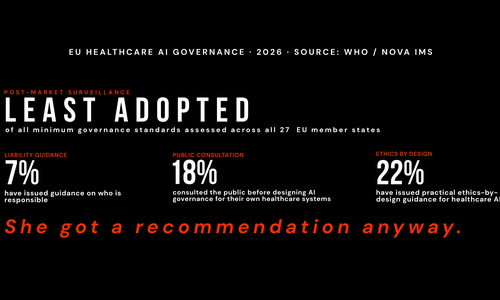
That is why output verification alone is lacking. Yes, fact-checking, source-checking, bias testing matter. Yet, organizations must go further and ask: What habits of mind are being formed or deteriorated? What assumptions are being normalized? What dependencies are being created? Who is becoming more powerful, and who is being asked to trust a system they cannot meaningfully question?
These are not abstract, philosophical concerns; they are operational ones, because the reason is simple: AI adoption is not a training event. It is a redesign of work, judgment, incentives, and accountability.
If people cannot recognize when AI is wrong, challenge its outputs, understand limitations, and remain responsible for the decisions that follow, the organization has not developed capability… it has created AI dependence. It has outsourced judgment.
Fusion Compass exists to close that gap.
We help organizations build the human side of AI engagement: applied skepticism, critical judgment, accountability, and the metacognitive awareness required to interact with AI without surrendering human agency.
To be clear, this is not anti-AI.
It is the opposite.
We believe AI can expand human possibility. It can reduce drudgery, accelerate insight, support creativity, improve access and strengthen decision-making. But none of those outcomes are automatic. They depend on the people, systems, and values surrounding it.
More AI does not guarantee better decisions.
Good judgment has always required knowing when to trust a tool, when to question it, and when to disregard it entirely.
AI is no different.
The challenge before us is not primarily technological, it is profoundly human. Our work is not merely to adopt or govern AI, but to develop people who can remain discerning, accountable, and fully-human in an AI-mediated world.
That is Fusion Compass.
Share this article
Related Articles
Cloudflare Wants to Secure Your AI Future. Read Their Incident Reports First.
Apr 22, 2026