Cheaper.
And provably
no worse.
Anyone can make a model cheaper by making it worse. We cut your LLM token spend and
prove the quality held — every change gated by Fusion Sentinel before it ships.
Anyone can make a model cheaper by making it worse. The value is cutting cost while proving quality held.
A demo that's cheaper is easy. A deployment that's cheaper and demonstrably no worse is the hard part — and the only one worth paying for.
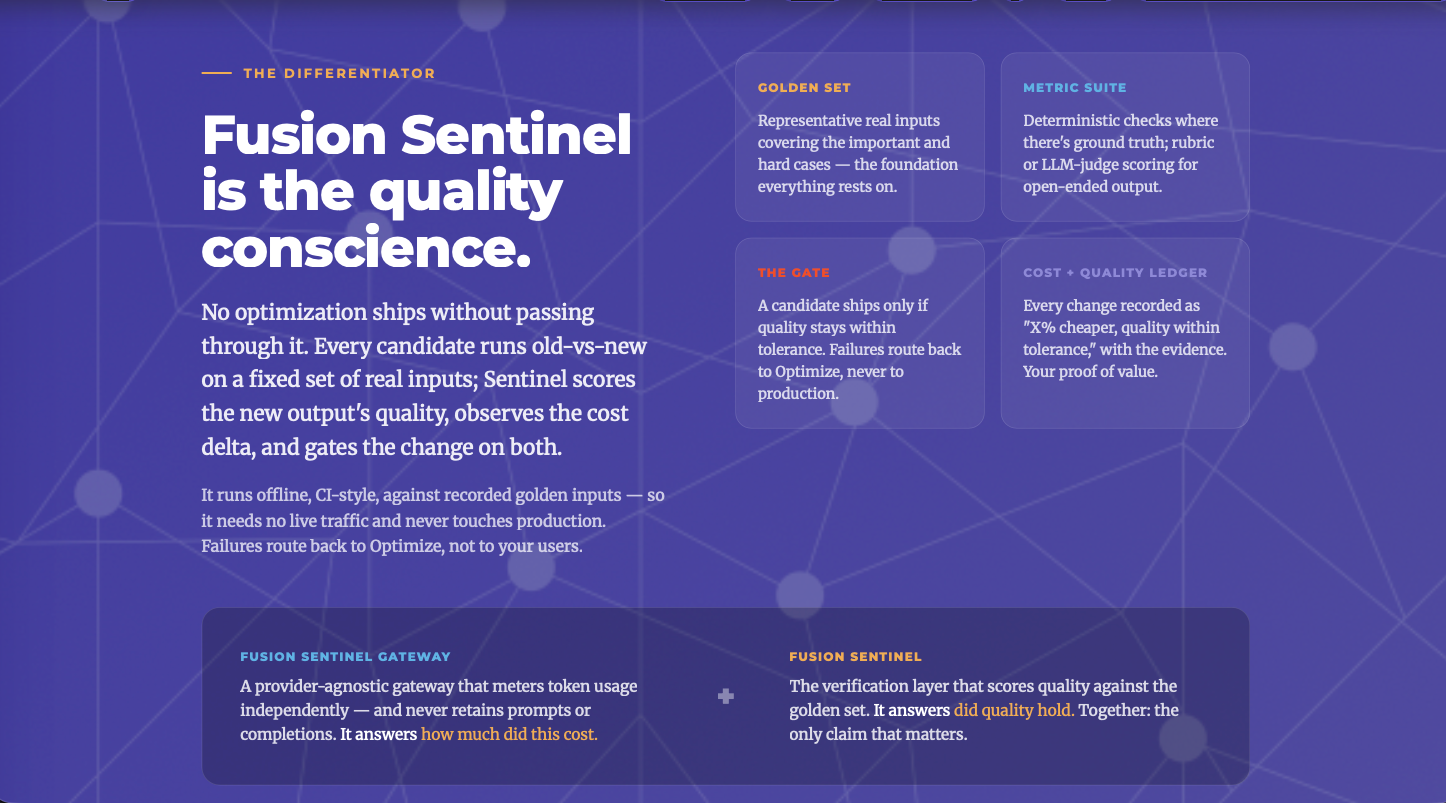
Token Optimization is a focused engagement that reduces your LLM token spend without degrading output quality. Every optimization runs old-vs-new on a fixed set of real inputs. Fusion Sentinel scores the new output, observes the cost delta, and ships the change only if quality stays within tolerance. The proof is the deliverable.
Your token bill is
growing. Nobody can say why
You cannot optimize what you cannot attribute and you cannot cut what you cannot verify.
Most teams are stuck on both.
We measure the spend, find the waste, and ship only the cuts that pass the gate.
Spend you can't attribute
A monthly total — not spend by feature, model or tenant. And output tokens cost several times more than input.
Waste hiding in plain sight
Bloated prompts, an over-powered model on a trivial task, an uncached prefix, unbounded output.
Cuts that quietly break things
Trim the wrong instruction, down-tier too far, and quality regresses where no one is watching.
No proof either way
No baseline, no quality gate — so every change is a guess you can't defend in a budget meeting.
Measure. Diagnose.
Optimize. Verify.
A disciplined loop: account for every token, find where it's wasted, apply the cheapest-risk levers first — and let nothing reach production without passing the gate.
Measure
Capture per-request token usage — input, output, cache and batch classes — tagged by feature, model and tenant.
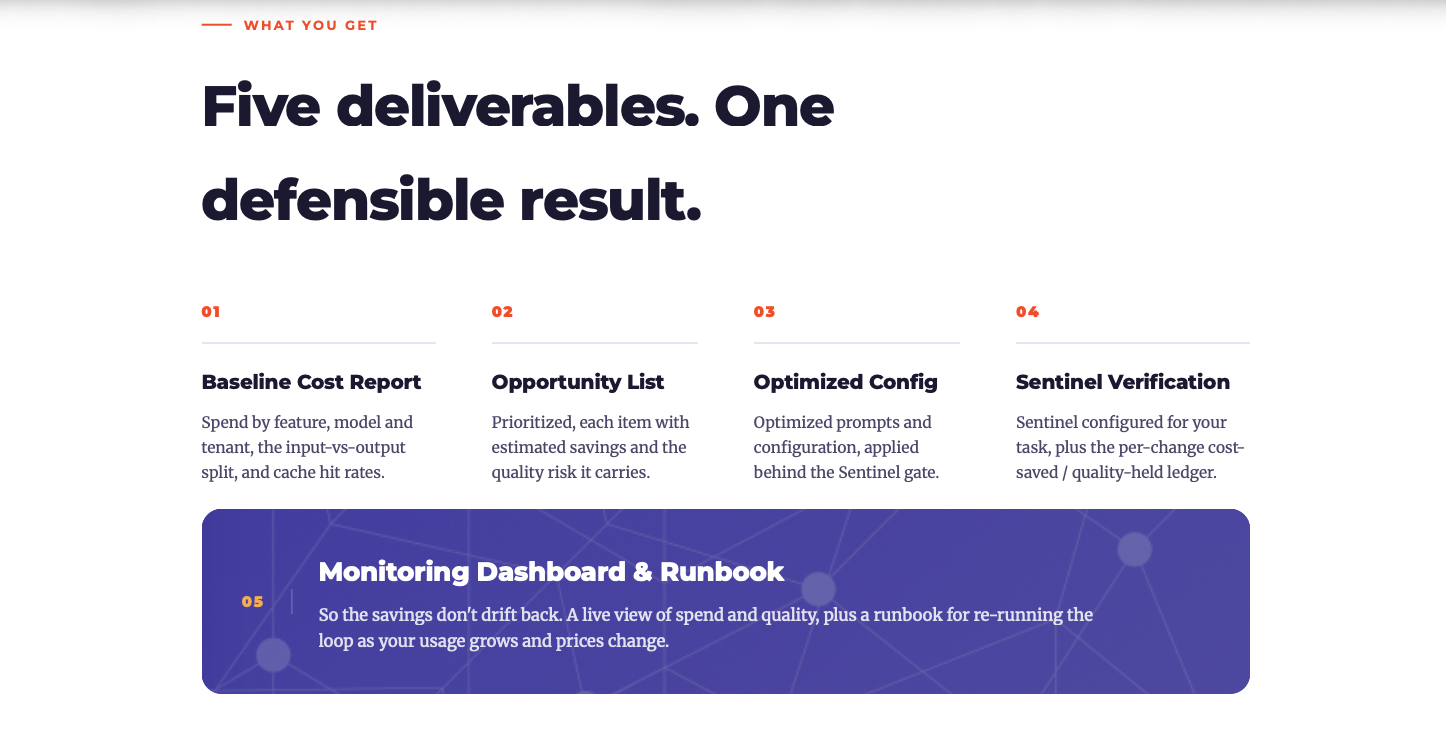
Outcome: Baseline cost report
Diagnose
Find where the tokens go and which are wasteful. The big wins are almost always in prompts and model routing.
Outcome: Prioritized opportunity list
Optimize
Apply the levers cheapest- risk first. Each carries a cost mechanism and a quality risk Sentinel is responsible for catching.
Outcome: Optimized prompts & config
Verify
Fusion Sentinel runs every candidate old-vs-new on a golden set and gates the change on quality and cost together.
Outcome: Cost saved/quality held ledger
Minimum viable engagement: token accounting, a prompt & model audit, and Fusion Sentinel. A complete, defensible deliverable on its own — everything else is added only when your spend justifies it.
Six levers. Each with
a known quality risk.
We pull them in order of risk-adjusted return — and Sentinel is the conscience that catches the regression each one can introduce.
Prompt slimming
Trim bloated system prompts, stale few-shot examples and verbose formatting. Fewer input tokens on every call.
RISK - dropping an instruction the model needed
Model routing
Stop running an over-powered model on a simple task. Plan with a strong model, execute with a cheaper one.
RISK - capability regression on the hard ones
Prompt caching
Often the single largest lever for high-volume apps — when the stable prefix is ordered first and cached.
Risk - low - need a correctly ordered prefix
Context tightening
Right-size RAG chunks and stop stuffing full history every turn. Truncate and summarize instead.
RISK - dropping context mattered
Output control
Bound and structure responses — the expensive tokens. Set max_tokens, terse instructions, structured output.
RISK - truncated or under specified answers
Batching
Move non-interactive work off the real-time path to claim the batch discount —wherever latency isn't required.
RISK - latency - only where real-time isn't needed.
Two kinds of spend. The same disciplined method
Don't cut your AI spend and cross your fingers
Cut it with proof.
We measure the spend, find the waste, apply the levers — and ship only the changes Fusion Sentinel certifies are cheaper, and provably no worse.
A complete, defensible engagement— starting with a baseline.
Looking to cut your AI spend?
Don't cross your fingers, cut it with proof. Contact the Fusion Collective Token Optimization practice today.