Your ATS is Working as Designed
If you run hiring, your ATS is quietly rejecting qualified people by design, not by accident. The data is damning, the lawsuits are real, and the regulatory clock runs out this August. Here's how to check whether the company getting served next is yours.

Emily Got the Interview. Aliyah Got the Silence.
You’ve heard me re-tell this story before. I put Aliyah Jones on the screen at Black Tech Fest 2025, in front of a room full of hiring leaders. I am telling it again because nothing has changed. Not her outcome, and not the system that produced it.
For 8 months, Jones kept two LinkedIn profiles running side by side. Her own: strong portfolio, real experience, real name. A second one: an AI-generated white woman named Emily Osbourne, identical resume, different face.
Jones applied to more than 300 jobs as both women.
- As herself, she got an interview request 8.9% of the time.
- As Emily, interview requests came in 57.9% of the time.
Same education.
Same experience.
Same words on the page.
The only variable? Who, or what, was reading them.
Jones isn’t an outlier and I had the data behind me when I said so.
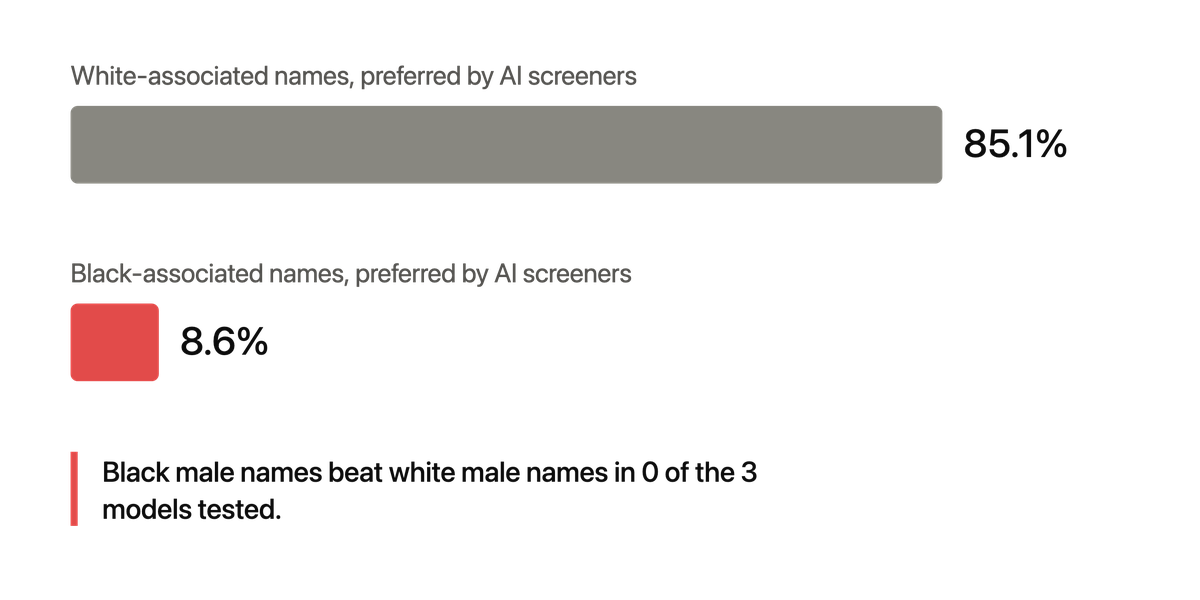
In 2024, University of Washington researchers ran the same test at scale. The fed 3 AI resume screening models 554 real resumes across 9 occupations.
- White-associated names won 85.1% of the time.
- Black-associated names won 8.6%.
Put a Black “sounding name” again a white male sounding name and the Black male sounding name lost every match up. Not most of them. Not some of them.
E-V-E-R-Y-T-I-M-E
Now open “Hidden Workers, Untapped Talent,” the 74-page report from Harvard Business School and Accenture, written specifically to explain why 27 million capable people can't get hired.
The report calls the applicant tracking system (ATS) broken. PSSST… it ain’t broken.
A recruiter facing 250+ applications/posting doesn’t want more people to review. They want a shorter list, and the software's entire pitch is a shorter list, a smaller pile, not a better hire. It’s doing its job.
88% of employers surveyed admitted their own process screens out qualified candidates. For middle-skills roles, that number climbed to 94%. They kept running it anyway. I said this on that stage too.
And take in the 27 million carefully, because almost nobody does. It’s not a current headcount. It’s a modeled estimate of a potential talent pool, most of whom are not sitting in anyone's rejection pile today. People are quoting it as hard fact. It’s an estimate.
Aliyah Jones could’ve told them for free.
Then look at page 48. I rasterized the "Five technology pitfalls to avoid" sidebar, and a production note nobody removed came up with it. Read it yourself:
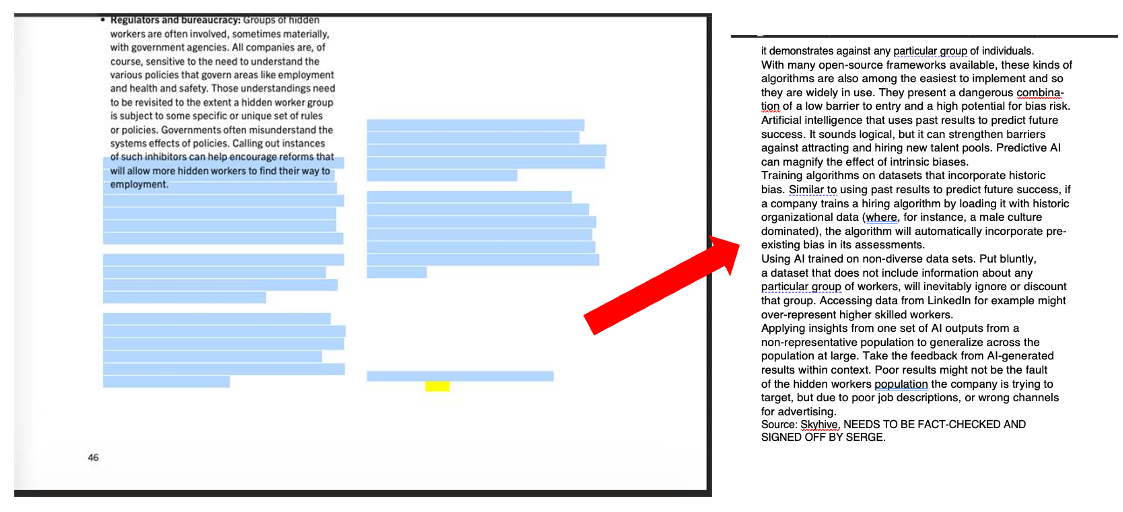
That shipped. Inside a report about how carelessly companies vet the people who apply to them. Did anyone fact check it? Did anyone ever find Serge? If that’s the care they gave their own research, ask how much they are giving yours.
But a lot has changed since that report went to print and since I stood on that stage last October.
Derek Mobley sued Workday in 2023. He says its screening software rejected him from more than 100 jobs over 7 years because of his race, age, and disability. A Federal judge has now ruled age discrimination law protects applicants, not only employees, and has let the case proceed as a collective action and rejected Workday's argument that it was just a neutral tool. Workday's software touched an estimated 1.1 billion applications across the years the suit covers.
Eightfold AI is fighting a different kind of case. Microsoft, PayPal, and dozens of other employers use its Match Score to rank candidates 0 to 5 on their predicted likelihood of success. In January 2026, 2 applicants sued, one of them, Sruti Bhaumik, applied for a Microsoft role titled Senior Technical Program Manager, Responsible AI (Job Number: 1841390). An algorithm rejected them 2 days later, before a single human read a word written. The complaint argues Eightfold quietly runs background checks under another name, scraping social media and location data into a profile the applicant never sees and cannot correct. That’s the exact behavior the Fair Credit Reporting Act was written to stop in 1970. Courts have stopped letting employers point at the vendor and call it someone else's problem.
The regulators are closing in. New York already requires an independent bias audit before a company can run a candidate through an automated hiring tool. The EU AI Act classifies recruitment software as high risk. A report that tells companies to justify hiring hidden workers with a “business case” for hiring hidden workers is arguing for a choice you no longer have.
So, do this now:
- Pull your job descriptions. Count what got added in the last 2 years without anything being removed.
- Ask your recruiting team which filters in your ATS (applicant tracking system) are set to exclude people rather than surface them.
- Ask when that system was last independently audited. Get a real answer, not a shrug.
- Ask your legal team whether they’ve read the Workday and Eightfold complaints, because opposing counsel already has.
Aliyah Jones didn't need a report to tell her what was happening to her resume. Neither did Derek Mobley. They needed one company willing to check its own system before the 99th rejection. I asked for that from a stage in 2025. I'm asking again.
If nobody in your building can answer #3, then the company I’m describing is yours.
Fix it before Emily gets another interview Aliyah earned, and before your company gets served the way Workday and Eightfold did.
Share this article
Related Articles

The Reskilling Illusion: When AI Transformation Means "You're Fired"
Oct 03, 2025