The System Screamed at a Snack and Stayed Quiet for a Gun
An AI flagged a bag of Doritos as a gun and missed a real shooter days later. Same tech, two failures. Here's what districts must demand before signing.

Months ago, I told you about Taki Allen. He was 16, waiting for a ride after football practice, with a crumpled bag of Doritos in his pocket. Eight police cars pulled up. Officers got out with guns drawn. They put him on his knees, cuffed him, and searched him. They found the chips. An AI gun detection system had read the bag as a firearm.
I wrote then that the false positive was the danger. I was half right. The new reporting shows the other half, and it is worse.
Omnilert, the vendor, called it a false positive and said the system functioned as intended. The superintendent agreed. One officer on bodycam put it plainly: AI is not the best.
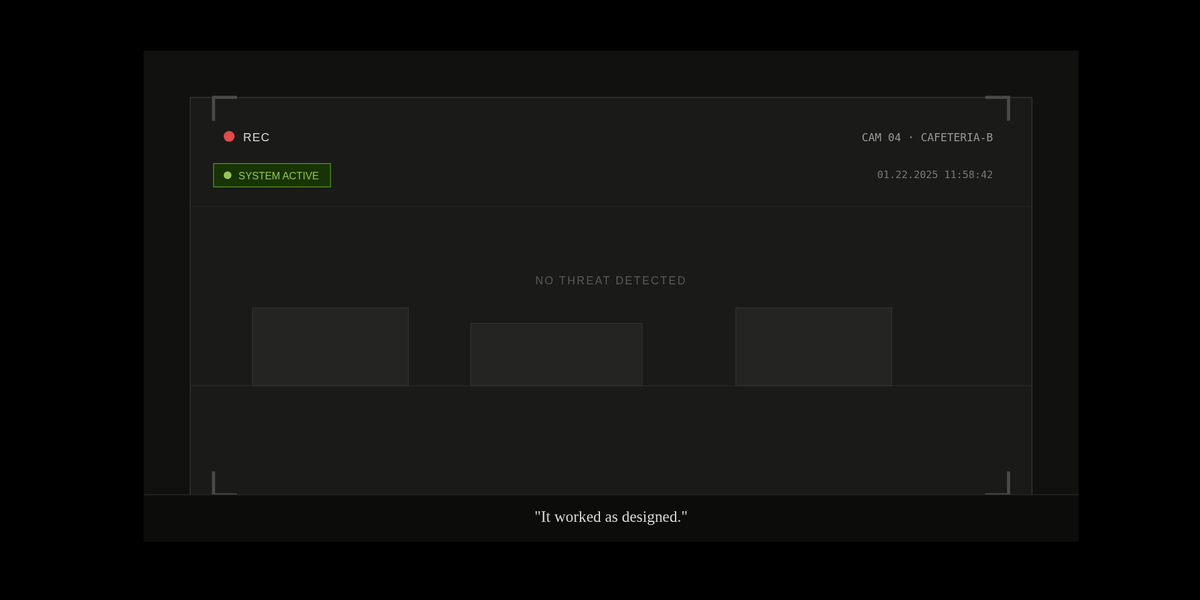
Now hold that against on January 22, 2025, a 17-year-old walked into Antioch High School in Nashville and fired ten shots in seventeen seconds. He killed a 16-year-old student and wounded another. The same brand of AI detection was active that day. It never saw the gun.
Henin is now suing Omnilert and the firm that installed the system. The complaint is the document every buyer should read. Omnilert sold unparalleled reliability and the power to spot a weapon before a shot is fired. It told schools the tool could have prevented Parkland. Then a gun crossed its own cafeteria and the system stayed quiet. After the shooting, the company edited its website and softened the promises about saving lives.
Here’s the tell. In Baltimore the system flagged a snack and the vendor said it worked. In Nashville it missed a shooter and the CEO said it didn’t malfunction; the gun simply wasn’t visible to a camera. Whether it fires at nothing or misses everything, the answer is the same. It worked as designed. And THAT, that’s what these schools bought. An unmeasured tool wired to armed response, failing in two directions at once.
When the output is officers with weapons drawn, your tolerance for a false positive is zero. You have no data that says you are anywhere near it.
The false positive puts a child at gunpoint. The false negative leaves a real shooter undetected. Both failures come from the same root: nobody can tell you how often either one happens. There are no independent, peer-reviewed studies on whether commercial AI weapons detection prevents shootings. The companies sell certainty. But the evidence? The evidence does not exist.
Regulators have seen this before. In 2024, the FTC took action against Evolv, a competitor, for deceptive claims about its detection. The settlement barred the company from making unsupported claims and let schools cancel their contracts after a student carried a knife past its scanners and stabbed a classmate in Utica, New York.
This is a $4B market. Omnilert is deployed in hundreds of schools, Evolv is widely used across school campuses, and Atlanta-area districts have spent millions on security upgrades, including scanners and other detection tech. What that money buys is expensive hardware whose real-world effectiveness is still thinly documented, with critics warning that some systems can produce false identifications and a fast track to police intervention.
Now let’s think like a buyer because that’s what district leaders are.
- You bought a sensor.
- You wired it to men with guns.
- You accepted the vendor's framing that an alert is success, even when the alert ends with a teenager on the ground.
But you never asked the only question that really matters: what does each error cost, given what the alert sets in motion?
The burden doesn’t fall evenly as the data shows who stands in that gap. Civil rights technologists call these tools probable-cause machines. In practice, school surveillance concentrates suspicion on Black and Hispanic students, functioning like a probable-cause machine. The cost is measurable: heavier surveillance is associated with lower math scores and fewer students going to college.
If you run a district or sit on a board, you can act this week.
- Freeze any wiring that auto-dispatches police from an AI alert. Detection and armed response must be separated by a trained human and a written protocol. The metal detector solved this decades ago: an alarm triggers a secondary screening, not a stop and frisk.
- Demand measured error rates before you sign anything. Ask for false-positive and false-negative numbers on independent data, not a vendor demo. If the company cannot produce them, you have your answer.
- Write the false-positive protocol first. Decide now what happens when the system is wrong, who makes the call, and what doesn’t get dispatched.
- Log every alert and every outcome. You can’t govern what you refuse to measure.
- Count the trade. Millions of dollars on scanners is millions of dollars not spent on counselors, who reduce violence with evidence behind them.
Taki Allen said he no longer feels safe waiting outside his own school. The technology meant to protect him taught him to fear the parking lot.
Behind every alert is a person and someone’s child. Measure the system or stop pointing it at kids.
Share this article
Related Articles

The Reskilling Illusion: When AI Transformation Means "You're Fired"
Oct 03, 2025