Tesla Calls It a Ban. The Bill Names No Company.

On S-1677 / A-3968, the New Jersey autonomous vehicle pilot, point and counterpoint.
Tesla is asking New Jersey residents to email the Legislature and oppose S-1677 and A-3968. The email makes five arguments.
I read the bill, audit AI systems for a living, and spent years documenting where autonomous vehicle oversight fails. And here’s what the bill actually says, and what Tesla left out of its email blast.
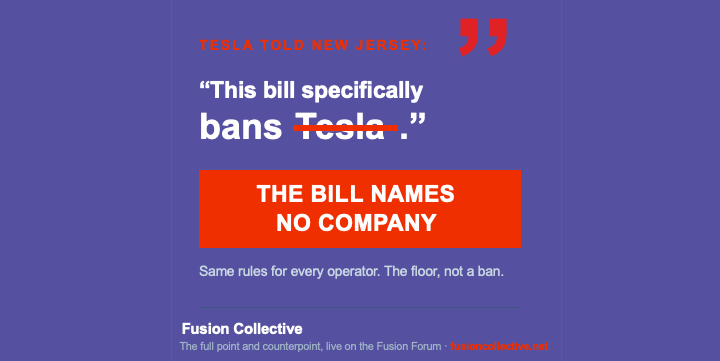
Let’s start with the claim everything else rests on. Tesla says the bill specifically bans Tesla.
Read the text. The bill names no company. It defines an autonomous vehicle tester and applies the same rules to every one of them: Waymo, Zoox, Wayve, Tesla. A company-neutral safety standard is not a ban. It is the floor.
Tesla’s Points vs. Facts
Tesla Advocacy Page States: The bill bans Tesla and is anti-competitive favoritism.
What the record shows: The bill applies one set of rules to ALL operators. It requires a trained safety operator during the testing phase, then conditions driverless operation on demonstrated safety and reporting. That’s the same staged path Waymo and every credible operator already follow. What Tesla calls a ban is a testing requirement Tesla wants to skip. Tesla's own ask confirms it: the company is lobbying to allow full driverless operation from the start. The bill doesn’t single out Tesla. It declines to let ANY operator skip the part that proves the cars are safe.
Tesla Advocacy Page States: Tesla's autonomous technology is proven.
What the record shows: Tesla's robotaxis logged 17 crashes reported to federal regulators in Austin between July 2025 and March 2026. Every crash involved the automated system engaged with a human safety monitor present. Federal regulators opened an inquiry after Tesla's cars were filmed driving on the wrong side of the road and braking erratically. Two of those crashes happened while a remote human operator was steering the car. Tesla's consumer software is rated Level 2, which by definition requires a human to supervise it. In California, all of Tesla's 1,000-plus robotaxis still operate with a human driver behind the wheel. The words proven and driverless are carrying a lot of weight in that statement.
Tesla Advocacy Page States: 94% of serious crashes are caused by human error, so autonomous vehicles will fix it.
What the record shows: That number comes from a single federal report. However, in the same report, the agency states the figure is not intended to be interpreted as the cause of the crash. The chair of the National Transportation Safety Board called the public use of that statistic dangerous and pushed to remove it from the agency website. Peer-reviewed research puts the share of crashes autonomous vehicles could realistically prevent closer to half, because recognition and decision errors, the two largest categories inside that 94%, are errors machines make too. In 2018 an autonomous Uber killed Elaine Herzberg after its system classified her as an unknown object. The 94% line is the most misused statistic in this debate, and Tesla led with it.
Tesla Advocacy Page States: Autonomous vehicles will create 455,000 jobs and $93 billion in tax revenue.
What the record shows: That pairing is the optimistic ceiling from a single consulting estimate (McKinsey), promoted by the autonomous vehicle industry's own trade groups. The same study's moderate case is 114,000 jobs, a quarter of the figure Tesla quoted. Independent research projects a net loss of 4.5 million jobs and $168 billion in annual wages from driving automation. Tesla gave you the ceiling and skipped the floor. A pilot program exists precisely to measure which projection New Jersey actually gets.
Tesla Advocacy Page States: New Jersey will fall behind while other states move forward.
What the record shows: New Jersey traffic deaths fell ~15% in 2025, from 684 to 582, through enforcement, driver education, and road engineering. The state already runs a Target Zero Commission with a goal of zero traffic deaths by 2040. New Jersey isn’t standing still, and it’s not waiting on one company to make its roads safer. The bill Tesla opposes requires crash reporting, 30 seconds of pre-crash data recording, pedestrian detection, automatic emergency braking, and $5 million in coverage per operator. Those are the exact conditions that let a regulator verify a safety claim instead of taking it on faith.
So, what is this really about?
Autonomous vehicles are coming to New Jersey. But that’s not the question. The question is whether YOU can verify they are safe before one carries a passenger, and whether you have the data to act when one fails.
And I built the answer already. Prepared for the Mayor of London, my London Autonomous Vehicle Safety Standard sets five consent conditions a transport authority can require before any operator carries a paying passenger. The same five apply here:
- Crash reports within 24 hours when the automated system was engaged.
- Monthly disengagement data showing how often the system fails and a human takes over.
- Pedestrian detection accuracy tested against New Jersey's actual demographics, not Phoenix's.
- Full crash narrative disclosure, no redactions.
- A written infrastructure resilience protocol specifying what every vehicle does when the power goes out.
That last one is not theoretical. In December 2025 a substation fire cut power to a third of San Francisco. Waymo's fleet stopped in intersections, blocked emergency routes, and had to be towed. The mayor called the operator's CEO personally to clear the streets. There was no protocol and no direct line. Tesla's email does not say a word about what its fleet does the night New Jersey's grid fails. The bill should require an answer before launch, not after a crisis. On the detection point, peer-reviewed research found a 7.52% accuracy gap between light-skin and dark-skin pedestrians across eight automated detection systems, rising to nearly 10% at night. New Jersey is one of the most diverse states in the country. The bill's pedestrian detection requirement is the reason that gap gets measured here instead of discovered after someone is hit.
The Ask
To my fellow New Jerseyans: Read the bill (if you don’t want to read the entire text, this document is a good summary), read Tesla’s statements and then think about how it really impacts NJ. Make the decision based off of your assessment not Tesla’s marketing blast.
To NJ elected officials: Keep the bill technology-neutral, which it already is. Keep the supervised testing phase and add the five consent conditions above as a requirement before commercial service. Then watch who objects.
Waymo published more than 170 million driverless miles of peer-reviewed safety data and has every reason to support a rigorous New Jersey standard. Tesla redacted its own crash narratives as confidential business information, then unredacted them only this year under pressure. The operator who publishes its data first owns the trusted standard. The operator who fights crash reporting is telling you what its crash reports would say.
New Jersey has something San Francisco did not: advance warning, consent authority, and time. Use all three before the first robotaxi carries its first passenger.
Share this article
Related Articles

The Reskilling Illusion: When AI Transformation Means "You're Fired"
Oct 03, 2025