AI Governance Is Not a Cost Center. It Is a Revenue Decision.

Your CFO cut the AI governance budget. They called it overhead.
Here’s what happened to organizations that made the same call.
- Cigna's PxDx algorithm reviewed and denied more than 300,000 insurance claims in two months, averaging 1.2 seconds of physician review per claim. The class action Kisting-Leung v. Cigna Corp. is currently active in the US District Court for the Eastern District of California.
- UnitedHealth's nH Predict algorithm is the subject of a federal class action in which plaintiffs allege a 90% appeal reversal rate, meaning nine out of ten AI-generated coverage denials were ultimately reversed on appeal. The case, Estate of Lokken v. UnitedHealth Group, is pending in the District of Minnesota.
Both organizations had vendor contracts. Neither contract protected them from the litigation.
What Does AI Litigation Actually Cost?
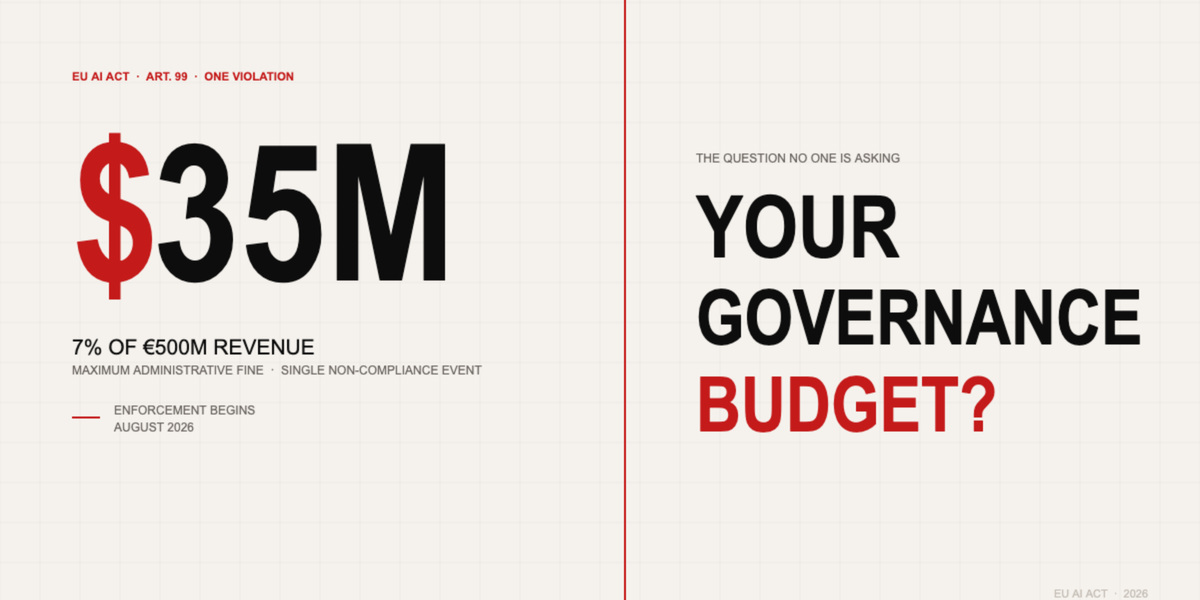
The EU AI Act, in force since August 2024, imposes fines of up to 35 million euros or 7% of global annual turnover for high-risk AI violations; whichever is the higher amount. For a mid-market company with $200 million in annual global revenue, a 7% penalty equals $14 million. For a company at $500 million in revenue, it equals $35 million.
These are the published figures from the European Union's official AI Act text, not projections. They are the operative enforcement framework for any high-risk AI system your organization deploys today.
Regulatory exposure compounds with litigation exposure. In July 2024, Meta settled biometric data claims with the State of Texas for $1.4 billion, the largest privacy settlement ever obtained by a single US state, after its facial recognition Tag Suggestions feature collected biometric identifiers without explicit user consent. In May 2025, Google reached a separate $1.4 billion settlement with the State of Texas over data privacy violations.
"For a company with $500M in annual revenue, a 7% EU AI Act fine equals $35 million. That is not the cost of governance. That is the cost of skipping it."
The pattern is consistent: organizations that deploy AI without documented governance face three simultaneous costs, regulatory fines, class action litigation, and reputational remediation. Governance built before the incident competes against all three at once.
Why Does Every AI Governance Conversation Die in the CFO's Office?
The frame is wrong.
Governance is presented as a cost to minimize. It belongs in the same budget category as insurance, legal retainer, and audit fees, risk transfer mechanisms that create financial stability.
The CFO's real question is not 'why are we spending on governance?' The correct question is: 'What is our maximum unhedged exposure without it?'
The RSM 2025 Middle Market AI Survey, which studied 966 North American organizations, found that 91% of mid-market companies use generative AI. Of those, 92% reported implementation challenges. The survey identified the most common challenges as governance failures: unclear ownership, unvetted models, no compliance documentation, no incident response. Each of those failures has a dollar value on the other side of an incident.
Fusion Collective has documented more than $50 million in compliance cost savings across hundreds of organizations audited. The methodology is consistent: organizations that build governance infrastructure before deployment avoid regulatory remediation costs, legal defense expenditure, and the operational disruption of a post-incident rebuild.
What Is the Revenue Case for AI Governance?
Beyond risk avoidance, there is a direct revenue argument most organizations have not yet made internally.
Enterprise procurement is systematically adding AI governance documentation as a vendor qualification criterion. ISO 42001 certification, the international standard for AI management systems, is the independently verified proof that your governance practices have been audited and confirmed by an accredited certification body. Organizations without it are losing enterprise contracts to those that hold it.
The Deloitte 2026 State of AI report, which surveyed 3,235 business and technology leaders across 24 countries, found that only 21% of companies have a mature governance model for AI agents, despite 75% planning agentic AI deployment within two years. Organizations that certify governance infrastructure now enter that procurement window ahead of the 79% that have not.
"21% of companies have mature governance for AI agents. 75% are deploying them within two years. The certified firms enter that procurement window ahead of everyone else." -- Deloitte 2026 State of AI
How Do You Build the CFO Business Case in Four Steps?
Step one: Calculate your maximum regulatory exposure. Take your global annual revenue, apply 7%, and compare to 35 million euros. The lower number is your EU AI Act penalty ceiling for a high-risk violation. Put that figure in the first slide of every governance budget discussion.
Step two: Map your active AI deployments against the EU AI Act risk tier framework. High-risk systems, those used in hiring, credit scoring, healthcare, and education, all require documented controls, human oversight mechanisms, and incident logging under current law. Identify your unprotected high-risk deployments before a regulator does.
Step three: Document one realistic incident scenario. Use the Cigna PxDx case as the reference model. Estimate your regulatory fine exposure, legal defense costs (typically $500K to $2M+ in discovery alone for a class action), and remediation timeline. That’s the number proactive governance competes against.
Step four: present governance as cost avoidance and a contract qualification credential, not a compliance expense. Those two frames produce different budget decisions from the same CFO.
The Bottom Line
Every organization in the Cigna, UnitedHealth, Meta, and Google cases had vendor contracts. None of those contracts protected them from the litigation or the regulatory enforcement. Governance, documented, certified, and continuously monitored, is the record of reasonable care that a vendor agreement will never create.
Fusion Collective has audited hundreds of AI systems and documented more than $50 million in compliance cost savings. The Profitable AI framework treats governance as a calculable asset, not an overhead line item.
The CFO conversation starts with a number. Bring the right ones.
Start building your governance program at www.fusioncollective.net
Share this article
Related Articles

The Reskilling Illusion: When AI Transformation Means "You're Fired"
Oct 03, 2025